Bitcoin Sees 9% Gain as Turmoil Hits the Forex Markets - Coindesk
Bitcoin Sees 9% Gain as Turmoil Hits the Forex Markets - Coindesk |
- Bitcoin Sees 9% Gain as Turmoil Hits the Forex Markets - Coindesk
- Breaking: Gaps all over FX charts, risk-off, tensions are... - Forex Crunch
- How to Use the Weekly Time Frame in Forex Trading - DailyForex.com
| Bitcoin Sees 9% Gain as Turmoil Hits the Forex Markets - Coindesk Posted: 19 Mar 2020 04:22 AM PDT
View
Bitcoin is on the rise Thursday morning (UTC), showing resilience in the face of a global dash for dollars seen in the foreign exchange markets. At time of writing, the cryptocurrency is trading near $5,670, representing a 9.4 percent gain on a 24-hour basis. Bitcoin found bids near $5,260 during the Asian trading hours and has been climbing since, according to CoinDesk's Bitcoin Price Index. While bitcoin is flashing green against the U.S. dollar, most fiat currencies are currently trading in the red. For example, the British pound-to-dollar exchange rate is hovering near 1.1555, the lowest level since 1980. The currency pair has dropped by nearly 8 percent this week. The Australian dollar fell to a 20-year low of 55 U.S. cents early on Thursday and is currently reporting a 0.6 percent drop on the day. The greenback has gained in the past six trading days against all major currencies, as noted by macro analyst Holger Zschaepitz. The surge indicates many investors are selling everything, even safe havens like Japan's yen and Swiss francs, to move their money into dollars over fears of a coronavirus-led recession in the global economy. "If cash is king, then dollar cash is currently being world president," according to ING's head of global markets. Bitcoin, however, isn't bowing down to the new cash overlord, and could see bigger gains if the U.S, equity markets put in a good performance in line with rising European stocks. At press time, the Euro Stoxx 50 – the eurozone's benchmark index – has added 1.3 percent to its value. A risk reset on Wall Street cannot be ruled out, as central banks from Australia to Canada have launched easing programs to inject massive amounts of liquidity into the system. Bitcoin's technical charts, too, are suggesting scope for a stronger recovery rally.
Daily chart Bitcoin defended the psychological support of $5,000 on Wednesday and ended up producing a small hammer candle, validating seller exhaustion signaled on Monday. A hammer candle occurs when sellers fail to keep prices at the lowest point of the day and is widely considered an early sign of a trend reversal. The MACD histogram is printing higher lows below the zero line, indicating a drop in bearish momentum.
Hourly chart Bitcoin produced a green marubozu candle in the 60 minutes to 10:00 UTC, which comprises a big body and small or no wicks. The bullish indicator shows buyers were in control from the session's open to its close. The odds appear stacked in favor of a rise to the top of the ascending triangle at $5,926. A high-volume break above that level could cause more bargain hunters to join the market, producing a stronger rise to the next resistance at $6,425 (December low). Conversely, a triangle breakdown would open the doors for a re-test of the March 16 low of $4,446. Disclosure: The author holds no cryptocurrency at the time of writing. Disclosure Read MoreThe leader in blockchain news, CoinDesk is a media outlet that strives for the highest journalistic standards and abides by a strict set of editorial policies. CoinDesk is an independent operating subsidiary of Digital Currency Group, which invests in cryptocurrencies and blockchain startups.  |
| Breaking: Gaps all over FX charts, risk-off, tensions are... - Forex Crunch Posted: 08 Mar 2020 12:00 AM PST 
The gaps in the open today portray a significant risk-off tone, laying down the foundations for a turbulent week ahead filled with plenty of risk events. There is even the possibility of non scheduled emergency announcements from global officials set on stabilising global financial and commodity markets. One thing is assured, and that is volatility. In the open, we have seen risk-off flows sending the yen to a fresh 104.14 high vs the greenback and the euro jump to a high of 1.1353 in a gap to mark a fresh high. The antipodeans have suffered a commodity-driven sell-off blow and the Canadian dollar is being strung out on the weekend news surrounding oil prices and a dead OPEC+ alliance, (more on that here).
The COVID-19 fears have intensified over the last 72 hours and financial markets are increasingly concerned about rising cases, including in the US and Europe and slow response in the US. There is a focus on the US bond market with yields plummeting a further 50% below the prior historic lows in the US 10-years, to a fresh low now sitting at 0.657%. This is weighing significantly on the greenback as the carry trade continues to unwind and as the Federal Reserve is seen to be cutting rates by a further 50% on the 18th March meeting. Globally, policymakers are stepping up to the plate in response to the global economic slowdown and it will not be surprising if we don't see further emergency calls to action this week. We have the European Central Bank and Reserve Bank of New Zealand on the cards. But its fiscal policy that the markets are going to be focussed on, as the central banks are a given, bar perhaps the ECB that seem reluctant to cut rates, and instead implement targeted measures to support corporate and SME lending. Ears are to the ground for extraordinary measures from global governments at this juncture. Chart of the week
 |
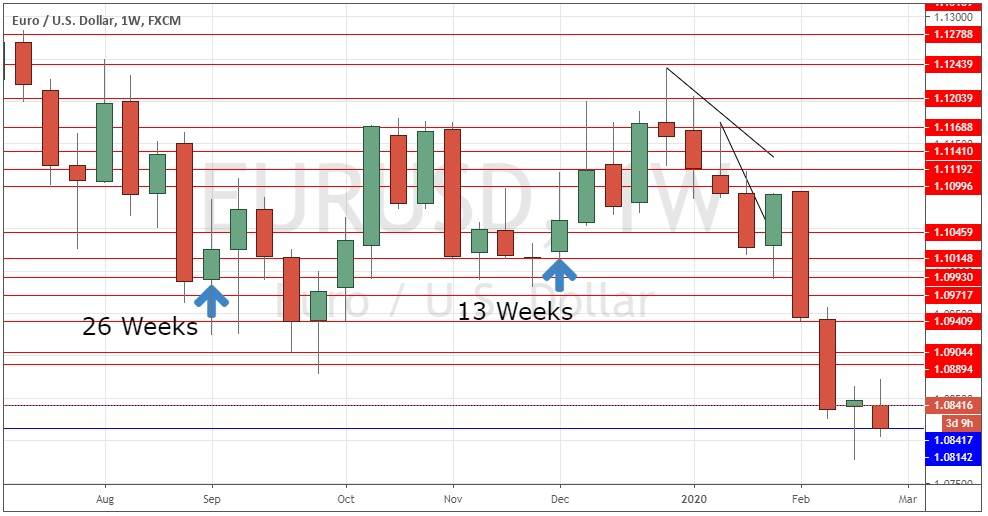
| How to Use the Weekly Time Frame in Forex Trading - DailyForex.com Posted: 28 Feb 2020 02:11 AM PST One of the main reasons why most Forex traders lose money is a failure to trade based upon longer-term, higher time frames such as the weekly time frame. This article explains why and how to use the weekly time frame in your Forex trading, and outlines both rules and actual historical performances of a few weekly time frame trading strategies which you might use or adapt. What is Time Frame in Forex Trading?"Time frame" in Forex trading means the unit of time that the price chart you are viewing is based on. For example, in a weekly time frame Japanese candlestick chart, each candlestick represents one week of time. In a 5-minute time frame Japanese candlestick chart, each candlestick represents 5 minutes of time. Shorter time frames show much more detail of price movement over time, but longer time frames show wider, longer-term pictures of trends and ranges in the price. Why You Should Use the Weekly Time Frame in Forex TradingThe most effective, profitable, and powerful tool you can use to trade Forex is to pay attention to whether or not there is a long-term trend or range in any currency pairs or crosses, especially the major pairs; and if so, in which direction that trend is going. Then, make sure that you trade in the same direction as that trend, or trade reversals from support and resistance when there is no trend and the price is ranging. Use a higher time frame price chart such as the weekly time frame to make these calls. While you can use a daily time frame chart for the same purpose, you should use the weekly time frame in Forex trading for this because it is easier to judge the very long-term price action at a glance there. It is also a good idea to drill down and use at least one shorter time frame chart as well, such as the 4 hour or hourly time frames, to fine-tune your trade entries and exits to make them more precise, which also means more profitable. How to Measure Trend with the Weekly Time FrameThe reason why the weekly time frame is the best time frame for trading Forex is because historical Forex data shows that when the price is higher than it was several months ago, it is more likely to rise than fall, and vice versa when the price is lower than it was several months ago. So, if you pull up a weekly chart, one easy trick you can do to create the best trend indicator, is count back 13 and 26 weeks from the current weekly candlestick. Is the price now higher than it was at those times? If yes, you have a long-term uptrend. If it was lower at both, you have a long-term downtrend. If the results are mixed, you have no trend. Forget all the fancy Forex indicators – this is a method which is both very simple and effective. For example, the weekly timeframe chart of the EUR/USD currency pair below shows the current weekly candlestick, on the far right, clearly below the opening prices of the candlesticks from 13 and 26 weeks ago. So, there is a clear downtrend, and this week traders can look for short trades in this currency pair.
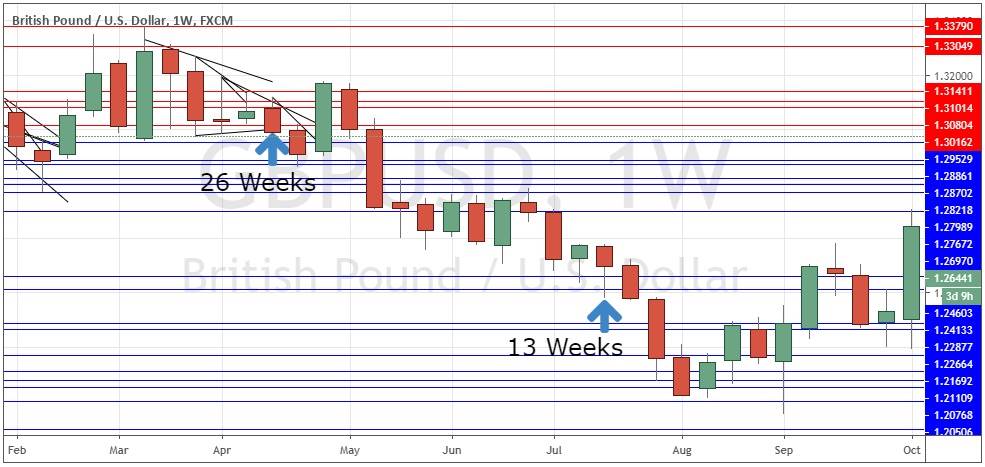
Weekly Time Frame: Long-term Downtrend In another example, the weekly timeframe chart of the GBP/USD currency pair below shows the current weekly candlestick, on the far right, closing above the opening price of the candlestick from 13 weeks ago, but also below the opening price of the candlestick from 26 weeks ago. So, there is no long-term trend, and next week traders who want to trade this currency pair should look to trade reversals at support and resistance levels.
Weekly Time Frame: No Long-term Trend Should You Use Only One Time Frame in Forex Trading?Although a weekly time frame chart can show you a trading edge, in all except very limited circumstances (explained in more detail below in the "Trading Forex with the Weekly Time Frame Only" section), it is not smart to trade using the weekly time frame alone. In fact, using just a single time frame to trade Forex is usually a bad idea, whatever time frame you might pick. However, using higher time frames such as the weekly price chart, can at least tell you whether there is a long-term trend and if so, in what direction. There are several reasons why trading using the weekly time frame alone is usually a bad idea:
Multi Time Frame Trading with the Weekly Time FrameMultiple time frame analysis is simply looking at two or more price charts for the same Forex currency pair or cross or other instrument, at the same time. You make a multiple time frame analysis by looking first at a higher time frame and using that chart to determine whether the price is trending (and if so, in what direction) or ranging, and also maybe to identify clear support and resistance levels. It is a top-down analysis, because once you have that information from the higher time frame, you then use a lower time frame to trade from that analysis, which will usually get you more precise trade entries and exits which should maximize your reward to risk ratio. There are a few good Forex trading strategies which have historically been profitable on the weekly time frame, outlined below. You can use a shorter time frame as a tool to trade these strategies more effectively. The results detailed below are from back tests conducted on sixteen major and minor Forex currency pairs over a very long period of almost 20 years, from 2001 to 2020. Thousands of samples were taken, increasing the statistical validity of the back test. Weekly Multi Time Frame Breakout Trend Strategy
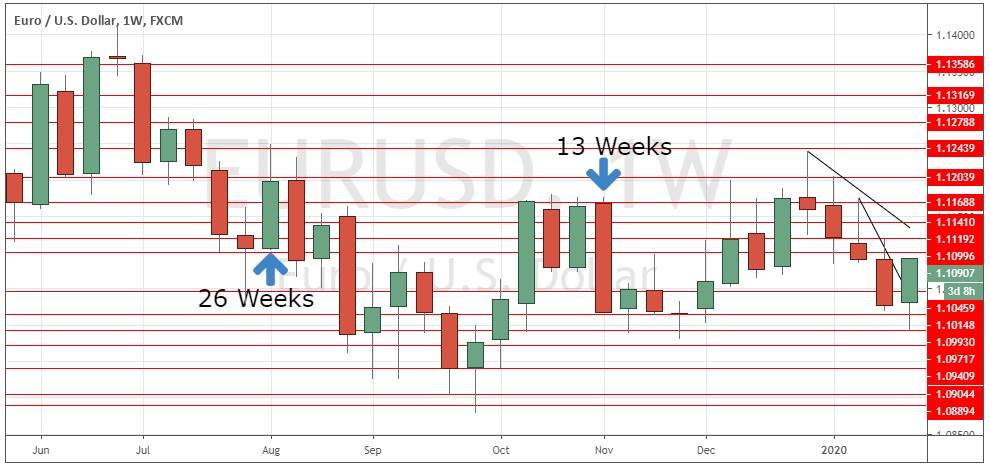
Weekly Breakout Trend Strategy: Short Trade Entry Weekly Multi Time Frame "Buy the Dips" Trend Strategy
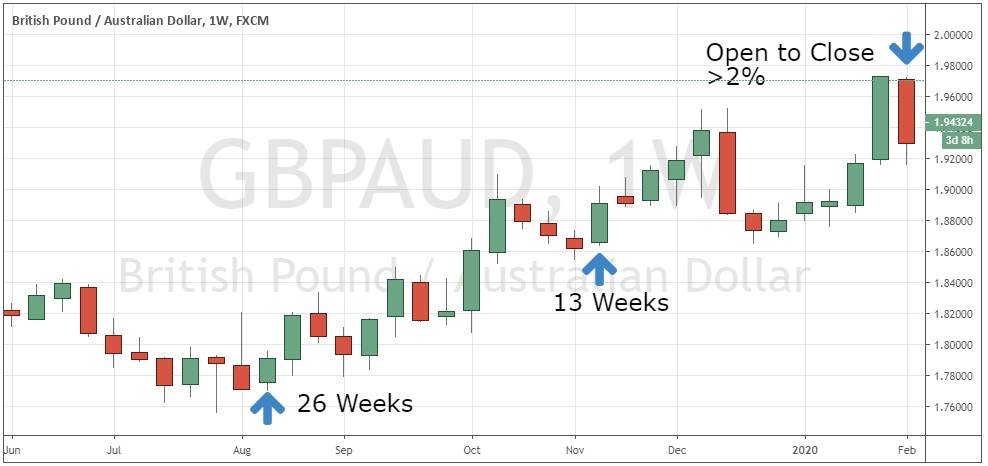
Weekly "Buy the Dips" Trend Strategy: Short Trade Entry There are also two weekly trading strategies with good track records which can more safely be used with only the weekly time frame. Trading with the Weekly Time Frame OnlyThese strategies produce trades which are meant to be entered just as a week ends, and held until the same time next week, without a stop loss. This can of course be traded more precisely by using a shorter time frame as well. Weekly Time Frame "Buy the Strong Dips" Trend Strategy
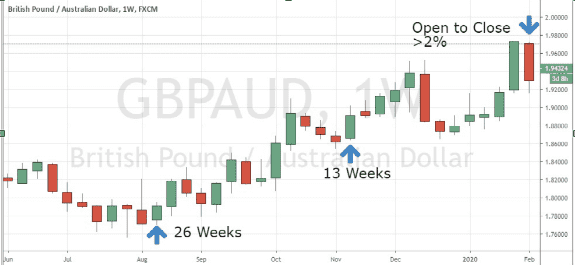
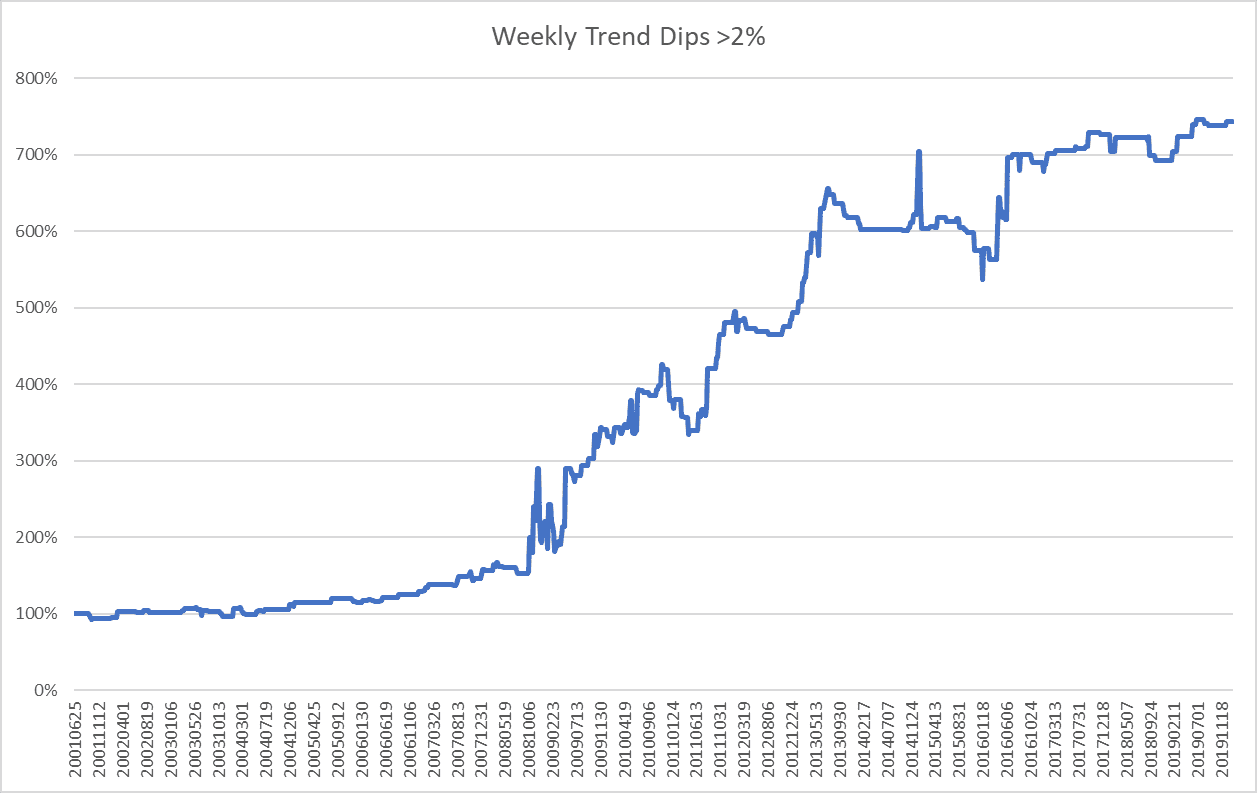
Weekly "Buy the Strong Dips" Trend Strategy: Long Trade Entry A back-test equity curve of this strategy using weekly moves from open to close greater than 2% in value trading 16 Forex currency pairs and crosses from 2001 to 2020 is shown below. Trades were hypothetically entered at the end of a qualifying week and held until the next week's close. Spreads and overnight financing payments/charges were not included.
Weekly "Buy the Strong Dips" Trend Strategy: Equity Curve Weekly Time Frame "High Volatility Mean Reversion" Strategy
Final Thoughts
 |
| You are subscribed to email updates from "forex charts" - Google News. To stop receiving these emails, you may unsubscribe now. | Email delivery powered by Google |
| Google, 1600 Amphitheatre Parkway, Mountain View, CA 94043, United States | |


Comments
Post a Comment