Why Novice Traders Should Work with an Online Forex Broker - The Good Men Project
Why Novice Traders Should Work with an Online Forex Broker - The Good Men Project |
- Why Novice Traders Should Work with an Online Forex Broker - The Good Men Project
- The Most Important Forex Indicators Every Trader Should Know - FX Leaders
- Forex Trading Truth or Lie? Uncovering the Truths of FX Trading - DailyFX
| Why Novice Traders Should Work with an Online Forex Broker - The Good Men Project Posted: 26 Oct 2019 05:04 PM PDT You should do your background study about Forex and how the market works before investing.
— Entering the Forex industry is no joke. It's almost like wandering a maze with absolutely no clues as to where to go. That is why it is wise to have a trainer who will guide you at every step so that you don't get lost. In the case of Forex trading, the online broker provides such services in order to guide you towards the best investment plans. The importance of online Forex brokersYou should do your background study about Forex and how the market works before investing. This is not a casino where you put a coin and spin the wheel. Forex trading involves a lot of patience, knowledge about the industry, and a little bit of luck. So, if you are just starting out, read some of the reasons why you should work with an online Forex broker: 1) Learn as you investProfessional traders are aware of the nuances of different Forex trading websites. But as a newcomer, you will need to understand the dashboard of the site, how to place your trade, check the current position of different currencies, and so on. That's where the online Forex broker site will help. These sites come with hundreds of webinars, free premium courses, videos, and quizzes that will help you learn about the trade quickly. You can also check the latest Forex news directly from the website. Forex Academy, for example, is a site that offers updated Forex news 24/7. 2) On-site educationHow much do you know about the Forex industry? Your knowledge will decide the success of your investments. Again, the more you learn, the more experience you gain. Otherwise, it will be like a casino where you spend money and ride on your luck to win a game. One of the best places to learn about the Forex industry is a broker website. These sites want you to invest in their own interest. That is why they provide educational articles and a detailed description of the ups and downs of the market. 3) User-friendly siteAs a beginner, you will find yourself in an unknown world without a map if you log in to a Forex trading site. There are pointers and graphs everywhere, there are odds showing on one corner, the site sends a popup asking you to invest in various currencies, and so on. You would want to get off the site as soon as you enter. On the contrary, a Forex broker site makes it easier for you to understand the operations of a trading website. Starting from your first trade to collecting your earnings from your investment, they will teach you everything as if you are a student. It depends on you how much you want to learn and spend time on the website. The more you practice, the lesser chances you have to incur a loss in your investments. So, if you plan to make it big in the Forex industry, try to start your career with an online broker site. You'll surely thank yourself for having an expert to guide you instead of doing things all by yourself. — This content is sponsored by Jim Bevin.Photo: Shutterstock  |
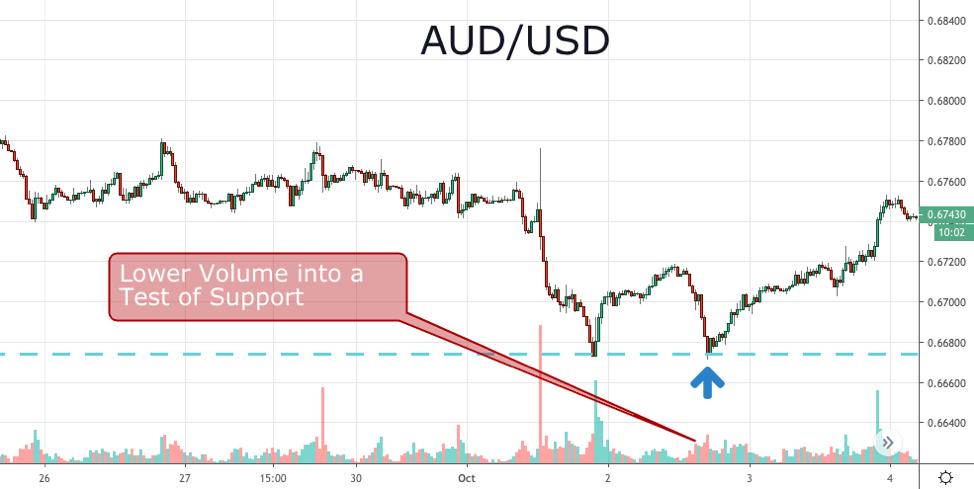
| The Most Important Forex Indicators Every Trader Should Know - FX Leaders Posted: 27 Oct 2019 02:03 AM PDT Forex indicators are at times a controversial subject. That's really because everyone has their own perception of what is a good indicator and it can be a very personal thing. Just as we have our own personal trading styles, it would stand to reason that we have our own personal indicators that would suit us best. So finding the best forex indicators for your style should be based firstly on a few different factors. Trending vs Mean-ReversionThe first thing you need to assess before you can even think about indicators is the type of market you're trading. All markets aren't equal and the most obvious example of this is the differences between forex, stocks and futures. For the most part, stocks are mean-reverting. That means that when they have a big move on a particular day, they invariably revert-back in the direction of where they came from. Futures, on the other hand, tend to trend. As they are based on big seasonal and fundamentals that are often playing out over weeks and months. Then there is forex, which can often be a combination of both. Some pairs such as the [[USD/JPY]] might be more likely to hold a range, based on the fundamentals and the fact that it has safe-haven like properties. So there will be times when it is trending (in times of uncertainty), but overall it will remain relatively steady. Whereas something like the [[AUD/USD]] which is sensitive to things like commodity prices, will often move in one direction and trend over multiple weeks or months. So that will determine to some degree, what is the most effective technical indicator and how you should use it. For example, trying to fade a strong trending forex pair using a Bollinger band strategy will likely now be successful. However, it might be highly effective for a more range-bound pair. The Downside of Technical IndicatorsWhile there are many benefits to using technicals to get a better gauge of price action, it needs to be noted that there is one glaring deficiency. That is the fact that technicals are a lagging indicator. That means that we are seeing a representation of what has happened in the past. Of course, there is no way to predict the future with 100% certainty, so technical indicators need to be used with that in mind. They are simply a guide in the trader's toolbox. The Best Forex IndicatorsKeeping what we have discussed in mind, we can now look at some of the best forex indicators for short-term traders. VolumeMany traders overlook volume in forex trading as it is not a perfect measurement like in other asset classes such as stocks or bonds. That's because there is no one centralized exchange that can track all the volume that takes place and much of the volume being done in forex is OTC. But as retail traders there is enough information for us to get an idea of what volume is doing. The most effective way to use volume is around key levels. When a key support or resistance level breaks on increasing volume, that is telling us that there are larger players, such as big traders or institutions that are present. That information is valuable to us because it tells us that there is more than likely going to be more volume coming in, in that same direction. In this instance, we can use volume as more of a leading indicator in the hopes that price will follow through in the same direction it has been trading. If the price tries to test a support level and can't break through and volume is lower than we previously saw, that would suggest the opposite and that that level will likely hold. We can see that in the following example below, where price couldn't break the key support level.
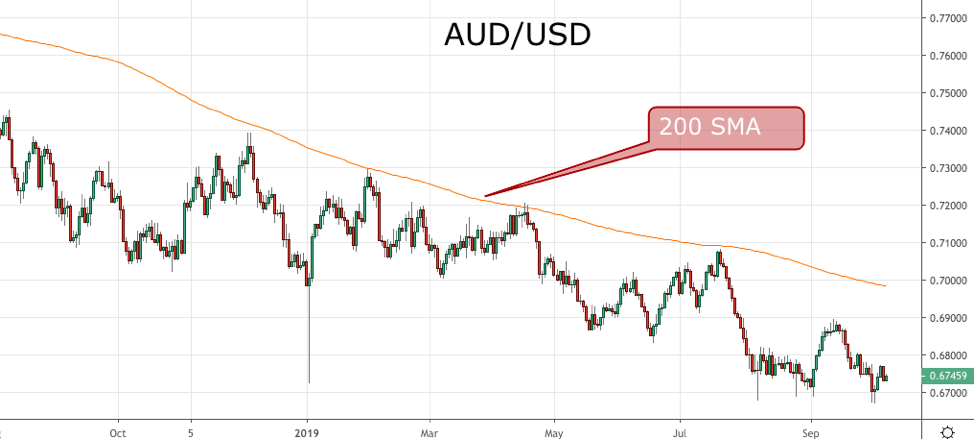
AUD/USD – 30min. Moving AveragesMoving averages might just be the most common and popular indicator of all and are used almost universally by traders. There are two ways we can use moving averages as a forex indicator, depending on your time-frames. The most obvious is as an area of support and resistance. The price will often times bounce off the key round number moving averages, such a 20, 50, 100 or 200. Of course, that number is applied to whatever time frame you are looking at. As such, we can get greatly varied results. In my opinion, this is a strategy best applied to a strongly trending market. You can also increase the effectiveness by applying some basic candlestick patterns to it. There is also a school of thought that by themselves, moving averages are not enough to make buy and sell decisions off alone. The second way we can use moving averages as a forex indicator is as a sentiment filter. What this effectively means is that we can use the position of the current price, relative to a longer-term moving average to gauge who is in control. The bulls or the bears. That gives us an idea of the direction of the trend over the longer-term and as we know in trading, it is always best to trade in the direction of the trend. So for example, if price is trading below the 200-SMA on a daily chart, that is a good indication that you need to be looking for opportunities to the short-side. AUD/USD – Daily. Keltner Channels and Bollinger BandsOne of the most effective strategies in forex trading is to buy pullbacks in an up-trending market and short pullbacks in a down-trending market. A very useful tool to identify areas to buy or sell, based on that idea is to use either Keltner Channels or Bollinger bands. While there are subtle differences in the two, both forex indicators, show how far price has moved from the mean, in terms of standard deviations. As a rule of thumb, using 2-2.25 standards deviations from the 20-EMA will give you a good starting point to build a trading strategy around. When price is trending and has tagged the upper or low bound of the Keltner Channel or Bollinger Band, then when it pulls back to a middle line – which is just a moving average, we have what is a good indicator that price will likely continue in that same direction. As mentioned before, a moving average alone might not be enough to use a raw signal, but in this type of instance, we are effectively using multiple indicators in one to buy and sell pullbacks in trending markets. Which as we know is a powerful strategy regardless of the timeframe or product we are trading.
AUD/USD – Daily Best Forex Indicator – A Combination of Multiple Forex IndicatorsAs we can see, by combining all three of the aforementioned forex indicators, we can start to build a powerful trading strategy. First, we need to identify markets that are trending. We can do that by looking at daily charts and identifying forex pairs that are above or below a 200-SMA. If a forex pair is above multiple SMA's such as the 50 and the 200, then we can assume the trend is stronger. From that point, we can use Keltner Channels to look for areas, where price has tagged one of the outer bounds, then pulled back to the moving average. Finally, we can add in breaks and tests of key support and resistance areas, where volume is increasing. They will be areas where you can either add to your positions or even exit trades when a level might fail at low volume. Ultimately, the right combination of forex indicators is one of personal preference. You need to find the indicators that fit your personality, style and timeframes that you like to trade.  |
| Forex Trading Truth or Lie? Uncovering the Truths of FX Trading - DailyFX Posted: 30 Sep 2019 12:00 AM PDT Do you know the truths about forex trading?Traders face a barrage of information when they start out in the markets – and being able to sort the wisdom from the folly could be the difference between success and failure. Should you risk 1% of your account per trade, or 5%? Does RSI work better than stochastics? And is Bitcoin really a reliable store of value? Granted, some topics will always be debatable, but with the help of our DailyFX expert analysts, we uncover the truth about forex trading, the lies, and the murky bits in between. Truth or Lie: Traders Need a Financial Background"Trading has little to do with 'finance' and more to do with understanding what is involved in performance-related endeavors" - Paul Robinson, Currency Strategist  A financial background can be useful for understanding how forex and other markets work. However, more beneficial are skills in math, engineering and hard sciences, which better prepare traders for analyzing and acting on economic factors and chart patterns. It doesn't matter how much awareness you have about financial markets – if you can't process new data quickly, methodically and in a focused manner, those same markets you thought you knew so well can eat you alive. ANSWER: LIE EXPERT TIP: To prepare for trading, focus on developing analytical skills rather than boning up on financial knowledge. Recommended reading: Truth or Lie: Trading is Easy"Trading is definitely easy. Being profitable is where the difficulty lies" - Peter Hanks, Analyst  Trading is like running a business. In order to be successful, you need to learn from mistakes and have rules in place to help protect your capital. Like a business, it's crucial to have appropriate strategies on hand for varying market conditions. Setting up a business is easy, and similarly, trading is easy too. Developing successful strategies and making money? That's the hard part. ANSWER: TRUTH EXPERT TIP: It will seem easy if your early trades go well, but long-term profitability is a different matter altogether. Make your life easier by researching your trades, using the right position size, setting stops and keeping a handle on your emotions. Recommended reading: Truth or Lie: You can't be successful with a small trading account"A 20% return is a 20% return regardless of the account size" - Paul Robinson  Can you be successful with a small trading account? It depends on your definition of successful. An account needs to be large enough to accommodate proper risk parameters. But success is relative; a high rate of return is based on percentages and not on monetary amounts. For example, a 20% return is a 20% return regardless of the account size. However, if your 20% return isn't worth enough in hard cash, it might be hard to incentivize yourself to improve as a trader. ANSWER: IT DEPENDS EXPERT TIP: Your account size will depend on your goals and your prior success. Naturally, experienced traders will have a larger account but to begin with, concentrate on that rate of return percentage. Recommended reading: Truth or Lie: A profitable trader wins most trades"Think quality of trades, not quantity of trades" - Nick Cawley, Analyst  Bragging rights be damned: the number of trades you win is irrelevant. Profitable traders simply make more money than they lose. Say you win five trades and make $5,000, but lose one trade and lose $6,000 – you have won more trades than you have lost but are still down overall. Profitable traders will set rigid risk-reward parameters for a trade – for example they might risk $500 to make $1,000, a risk-reward ratio of 1:2. If a trader makes five trades using this method, loses three of them and wins two of them, the trader is still $500 in profit ($2,000 profit-$1,500 loss). Don't be afraid of taking a few hits: if your process is sound, one big winning trade can reverse your fortunes. ANSWER: LIE EXPERT TIP: Many successful traders will be losing more trades than they win, but oftentimes it won't bother them. Focus on getting the right setups rather than worrying about the ones that got away. Recommended reading: Truth or Lie: You need to spend a lot of time monitoring trades"Spending too much time monitoring trades can work against you as the temptation to micromanage becomes too great" - Paul Robinson  How much time you spend trading, and monitoring trades, will depend on your trading style. Those employing a scalping strategy, for instance, will make a large number of transactions per day, entering and exiting many positions, and will need to pay close attention to their trades on the shortest timeframes. However, position traders won't need to spend as much time monitoring, as their transactions may last weeks, months or even longer – meaning long-term analysis will account for short-term fluctuations. ANSWER: IT DEPENDS EXPERT TIP: Ask yourself what type of trader you are. Shorter timeframes will mean monitoring and analyzing constantly – being 'always on'. If you favor a more relaxed approach you may be suited better for position trading. Recommended reading: Truth or Lie: A solid stop loss trumps a 'mental stop loss'"Reckless traders use a mental stop loss. Disciplined traders use a real stop loss" - Nick Cawley  Some traders advocate a 'mental stop loss' when the market gets tough – that is, relying on oneself rather than a computer to set a level at which to exit a losing position. The problem is, a 'mental stop loss' is just a number that makes you worried about the money you're losing. You may fret about the direction of the market - but you won't necessarily be compelled to exit your trade. A fixed forex stop loss is completely different – if your stop loss price trades you are out of the position, no ifs or buts. Exercising proper money and risk management means setting solid stops. Period. Answer: TRUTH EXPERT TIP: It can be so easy to neglect your stop loss. When a trade is going your way, the dollar signs can blind you - but you should protect yourself against the market turning. Recommended reading: Truth or Lie: Success comes from trading markets with the tightest spreads"The best opportunities shouldn't be fragile enough in profit potential that a larger-than-normal spread is going to make or break the ability to be profitable" - Paul Robinson  Spreads may represent the primary cost of trading, but they aren't the be-all-end-all when it comes to choosing your market. You may find an asset that has a wide spread but represents a strong opportunity due to its volatility. Similarly, you may find an asset with high liquidity and a tight spread, but that isn't showing much trading potential. Above all, you should let your trading decisions be governed by setups presented by the market, not the size of the spread. Answer: LIE EXPERT TIP: The spread can represent a significant cost to traders – but don't let it be the sole factor dictating your choice of asset. Recommended reading: Truth or Lie: Expertise in economic analysis is important"Economic analysis is only one part of trading. Economic analysis and technical analysis go hand-in-hand" - David Song, Currency Strategist  The economic analysis key to a fundamental approach helps give traders a broader view of the market. Sound knowledge of the underlying forces of the economy, industries and even individual companies can enable a trader to forecast future prices and developments. This is different to technical analysis, which helps to identify key price levels and historical patterns, and provides conviction for entering/exiting a trade. It's true to say that expertise in economic analysis is important. However, so too is expertise in the technicals. Many successful traders will look to combine fundamental and technical analysis so as to be in a position to draw on as wide a range of data as possible. Answer: TRUTH EXPERT TIP: It may be worthwhile to devise a strategy accounting for the nuances of both technical and fundamental analysis. Recommended reading: Truth or Lie: Trading the news provides the biggest opportunities"Correctly capturing a broader theme can be far more fruitful than 'trading the news' per se" - Paul Robinson  News can create big moves in the market, but that doesn't mean trading the news leads to the biggest opportunities. For a start, the volatility of important news events often makes spreads wider, in turn increasing trading costs and hitting your bottom line. Slippage, or when you get filled at a different price than you intended, can also hit your profitability in volatile markets. On top of these drawbacks, traders could get locked out, making them helpless to correct a trade that moves against them. ANSWER: LIE EXPERT TIP: 'Trading the news' can seem like a fashionable thing to do, but market movements can be unpredictable at the time of major releases. It's often best to steer clear during such high volatility. Recommended reading: Truth or Lie: Managing your emotions when trading is vital"Negative emotions like fear and greed can be managed without suppressing positive ones" - Paul Robinson  Excluding emotions from trading is an impossible endeavor. It can lead to more internal conflict than benefits, which is why managing emotions is a better way of looking at it. You have negative emotions like fear and greed that need to be managed without suppressing positive ones like conviction that help drive you towards the best opportunities. Answer: TRUTH EXPERT TIP: Even the most experienced traders feel emotion in the heat of the markets, but how they harness that emotion makes all the difference. Recommended reading: Anything we didn't mention? Leave a comment to give us your own truth about trading, and make sure to share this article on social media.  |

| You are subscribed to email updates from "best forex traders" - Google News. To stop receiving these emails, you may unsubscribe now. | Email delivery powered by Google |
| Google, 1600 Amphitheatre Parkway, Mountain View, CA 94043, United States | |


Comments
Post a Comment